Week 5 Day 1, 2, & 3: Continuation of Word Development and Entry to Wiktionary

I revised the word entry layout/rules based on the layout provided by Wiktionary and added the following rules to our website: http://www.nepalinlp.org:

  • A word’s language (as a level 2 heading, e.g.: ==Nepali==),
  • Its part of speech or “type” (as a level 3 heading, e.g.: ===Noun/pronoun/adj===),
  • The word itself (using the correct headword template),[3]
  • Word phonetic transcriptions are written inside square brackets ([ ]) and phonemic transcriptions are placed between diagonal strokes (/ /),
  • A definition (preceded by “#”, which causes automatic numbering),
  • Examples of words are written with “#” at the beginning which automatically creates serial numbers
  • Synonyms and Derived terms are written inside double square brackets ([[ ]]) in the link format. The text color notifies that if the word is in blue color then, the word is available on Wiktionary whereas if the word is in red color then, the very word doesn’t exist in Wiktionary. If someone would like to add the content about the word in red color, they can click on it and add the content in the format given below.

Words Development and Addition to Wiktionary

I looked up unlisted words and added seven more words to the website: https://nepalinlp.org/word-entry-template-and-examples/ and finally to the Wiktionary: Contributions to Nepali Wiktionary. The newly added words are as follows:

Word #5: तयार

==नेपाली==
तयार

==उच्चारण==
[tayāra], [tayaara]

==पदवर्ग==
विशेषण

===अर्थ १===
# बन्नुपर्ने कुनै वस्तु बनेर ठीक भएको; तैयार। 

====उदाहरण==== 
# अनुको घर बनेर तयार भइसक्यो। 

===अर्थ २===
# हिँड्ने, खाने, लाउने आदि [[आवश्यक]] कामकुराको ठीकठाक; [[तम्तयार]]।

====उदाहरण==== 
# आमाले अमेरिका फर्किने बेलामा खानेकुराहरु झोलामा नफुट्ने गरि राम्ररी तयार गर्दिनु भएको थियो। 
# रामेको छोरा बेलायत जानलाई तयार छ। 

==समानार्थी शब्द== 
[[तरखर]], [[तत्पर]], [[तैयार]], [[दुरुस्त]]

==व्युत्पन्न सर्तहरू== 
[[तयारी]], [[तयारी समिति]], [[तयारी स्रेस्ता]], [[तयार गर्नु]], [[तयार पार्नु]], [[तयार बस्नु]], [[तयार हुनु]]
 
==अनुवाद== 
अङ्ग्रेजी: [[prepared]], [[ready]], [[developed]], [[finished]], [[ripe]], [[created]], [[tailored]]

Word #6: सजाय

==नेपाली==
सजाय

==उच्चारण==
[sajāya], [sajaaya]   

==पदवर्ग==
नाम

===अर्थ १===
# कुनै [[दोष]] वा [[अभियोग]] [[प्रमाणित]] भएपछि दिइने [[शारीरिक]] वा [[आर्थिक]] [[दण्ड]]
# दण्ड र [[कैद]]मध्ये कुनै एक वा दुवै; [[कारावास]]।
 
====उदाहरण==== 
# अदालतले पौललाई एउटी नाबालक केटीको [[बलात्कार]] गरेको [[आरोप]]मा ५ वर्षको लागि कारावास हुने सजाय सुनाएको छ। 

===अर्थ २===
# कुनै कामकुराका निम्ति दिइने [[सास्ती]]; [[यातना]]; [[शासना]]।

====उदाहरण==== 
# मालिकले रमालाई जति राम्ररी काम गर्दा पनि सजाय दिरहेको हुन्छ। 

===अर्थ ३ ===
# [[दण्डजरिवाना]]।

====उदाहरण==== 
# प्रेमले एउटा मान्छेलाई कुटपिट गरेकोले रू. १०००० [[क्षतिपुर्ती]] दिने सजाय पाएको छ।   

==समानार्थी शब्द== 
[[दन्ड]] 

==व्युत्पन्न सर्तहरू== 
[[सजाय गर्न योग्य]], [[सजाय शुल्क]], [[सजाय सहन]]
 
==अनुवाद== 
अङ्ग्रेजी: [[punishment]], [[penalties]], [[penalty]], [[retribution]]

Word #7: जवाफ

==नेपाली==
जवाफ

==उच्चारण==
[javāpha], [javaapha]   

==पदवर्ग==
नाम

===अर्थ १===
# [[उत्तर]]; उत्तर पक्ष; [[उत्तरा]]; [[प्रतिवचन]]

====उदाहरण==== 
# श्यामले आफ्नो [[प्रियसी]]लाई छोडेर जाने कारण सोध्दा प्रियसीले केहि [[जवाफ]] दीनन। 

==समानार्थी शब्द== 
[[उत्तर]], [[प्रतिक्रिया]], 

==व्युत्पन्न सर्तहरू== 
[[जवाफदेही]], [[जवाफ माग्नु]], [[जवाफ दिनु]]
 
==अनुवाद== 
अङ्ग्रेजी: [[answer]], [[reply]], [[response]]

Word #8: विचार

==नेपाली==
विचार

==उच्चारण==
[bicāra], [bicaara], /ʋɪ.t͡ʃɑːɾ/

==पदवर्ग==
नाम

===अर्थ १===
# कुनै [[समस्या]], [[विषय]] वा [[स्थिति]]बारे गहिरिएर सोच्ने काम
# मनमनै गरिने [[चिन्तन]]; [[मनन]]। 
 
====उदाहरण==== 
# म आज [[विद्यालय]] जाऊ कि नजाऊ भनेर [[विचार]] गर्दै छु। 

===अर्थ २===
# मनले सोचेको वा सोचेर टुङ्गो लगाएको कुरो; [[सङ्कल्प]]; [[ठहर]]।

====उदाहरण==== 
# विद्या आफ्नो [[जीवन]]मा के गर्ने भनेर विचार गरिसकेकी छिन्। 

===अर्थ ३ ===
# मनको [[सोचाइ]]; मनको [[अनुभूति]]।

====उदाहरण==== 
# मेरो विचारमा राम ऐक [[असल]] मानिष हो। 

===अर्थ ४  ===
# [[तत्त्व–परीक्षा]]; ताइिभ्वक [[तर्कवितर्क]]।

====उदाहरण==== 
# मैले मेरो आमाबुवासित [[विचारविमर्श]] गरेर [[स्नातक]] तहको शिक्षा हासिल गर्ने [[निधो]] गरे। 

===अर्थ ५  ===
# वादी र प्रतिवादीका प्रमाण बुझेर सम्बन्धित क्षेत्रबाट मुद्दा छिन्ने काम; [[फैसला]]।

====उदाहरण==== 
# हिजो, औरैया गाउमा गौपलिकाले हरेक [[हफ्ता]] [[फोहोर]] [[संकलन]] गर्न [[गाडी]] पठाउने विचार [[पारित]] गरे। 

===अर्थ ६  ===
# [[सत्य]] र [[असत्य]] कुरा छुट्ट्याउने [[बुद्धि]]; [[विवेक]]।

====उदाहरण==== 
# बालेनको सरसफाईलाई [[प्राथमिक्ता]] दिने विचार सारै [[प्रसंसनिय]] छ। 

==समानार्थी शब्द== 
[[सङ्कल्प]], [[ठहर]], [[मनन]], [[विवेक]], [[फैसला]], [[तर्कवितर्क]]

==व्युत्पन्न सर्तहरू== 
[[विचार गर्नु]]
 
==अनुवाद== 
अङ्ग्रेजी: [[thought]], [[consideration]], [[idea]], [[opinion]], [[plan]], [[decision]], [[resolve]

Word #9: निकाय

==नेपाली==
निकाय

==उच्चारण==
[nikāya], [nikaaya]   

==पदवर्ग==
नाम

===अर्थ १===
# [[समूह]]; [[समुदाय]] 

====उदाहरण==== 
# नेपालको [[ग्रामीण]] क्षेत्रमा [[बसोवास]] गर्ने मुसहर निकायले उनीहरुकालागि [[शौचालय]] बनाइदिने [[माग]] गरेका छन्। 

===अर्थ २===
# समुदायअन्तर्गतको एक [[खण्ड]]; [[एकाइ]]।

====उदाहरण==== 
# [[शिक्षा]] अन्तर्गत रहेका [[प्राविधिक]] शिक्षा निकायले घरेलु आइमाईहरुलाई सिलाई मसिन बाड्ने निर्णय गरेको छ। 

===अर्थ ३ ===
# कुनै [[संस्था]] वा [[सदन]]।

====उदाहरण==== 
# ग्रामिण [[विकास]] केन्द्र भन्ने निकायले रौतहट जिल्लामा [[गरीब]] मनिषहरुलाई धेरै नै [[साहेता]] गरिरहेको हुन्छ। 

==समानार्थी शब्द== 
[[संस्था]], [[सदन]], [[एकाइ]], [[समूह]]

==व्युत्पन्न सर्तहरू== 
[[निकायको]], [[निकायसंग सम्बन्धित]]

==अनुवाद== 
अङ्ग्रेजी: [[department]], [[section]], [[body part]], [[part]], [[area]], [[sector]]

Word #10: वृद्धि

==नेपाली==
वृद्धि

==उच्चारण==
[vŕddhi], /ʋɾɪd̪.d̪ʱiː/ 

==पदवर्ग==
नाम

===अर्थ १===
# बढ्ने काम; [[बढ्ती]]। 
 
====उदाहरण==== 
# आजभोलि [[गर्भनिरोधक]] पदार्थहरुको प्रयोगले गर्दा विश्वकै [[जनसंख्या]] वृद्धि [[दर]] घटेको पाइन्छ। 

===अर्थ २===
# [[बढोत्तरी]]; [[उन्नति]]।

====उदाहरण==== 
# सही गलतको [[बिच]]मा [[फरक]] [[छुट्टयाउन]] सक्नु पनि वृद्धि हो। 

===अर्थ ३===
# [[लाभ]]; [[नाफा]]।

====उदाहरण==== 
# यस [[वर्ष]] कारोबारको वृद्धिले गर्दा [[मुस्कान]] र उनका [[परीवार]] धेरै [[खुसि]] छन।  

==पदवर्ग==
क्रिया 

===अर्थ १===
# बढ्नु 
 
====उदाहरण==== 
# भगवानको [[आराधना]] गरेपछि [[अन्नधन]]मा वृद्धि भएको छ। 

===अर्थ २===
# उन्नति गर्नु  
 
====उदाहरण==== 
# अपुर्वाले [[पच्हिलो]] ५ [[वर्ष]]मा आफ्नो जीवनमा निकै वृद्धि गरे। 

==समानार्थी शब्द== 
[[उन्नति]], [[प्रगति]], [[लाभ]] 

==व्युत्पन्न सर्तहरू== 
[[वृद्धि दर]], [[वृद्धिनकर]], [[वृद्धि काल]], [[वृद्धि श्राद्ध]], [[वृद्धिशील]], [[वृद्धिश्राद्ध]] 
 
==अनुवाद== 
अङ्ग्रेजी: [[growth]], [[increase]], [[progress]], [[proliferate]], [[propogate]], [[rise]], [[shoot up]]

Word #11: निर्णय

==नेपाली==
निर्णय

==उच्चारण==
[nirṇaya], /nɪɾ.ɳəj/    

==पदवर्ग==
नाम

===अर्थ १===
# पक्षविपक्षका जिकिरलाई प्रमाणका [[आधार]]मा [[छानवीन]] गरी सत्यपक्षको [[विजय]]बारे गरिएको [[टुङ्गो]]; [[फैसला]]।
 
====उदाहरण==== 
# म घर जाने कि नजाने निर्णय छैन। 
# तिमीले परिवारको [[दबाव]]मा आएर उसलाई छोड्छौ कि छोदैनौ तिम्रो निर्णयमा भर पर्छ। 

===अर्थ २ ===
# दुई [[विरोधी]]हरूको [[विवाद]]बारे [[मध्यस्थ]]ले दिएको [[मत]]। 
 
====उदाहरण==== 
# [[अदालत]]का सबै [[न्यायेधिष]]हरुले सबै प्रमाणलाई हेरे र सुनेपछि रामसिंहलाई [[देशनिकाला]] गर्ने निर्णय दिए। 

==पदवर्ग==
क्रिया 

===अर्थ १ ===
# निधो गर्नु
# फैसला गर्नु 
 
====उदाहरण==== 
# मैले निर्यण गरिसके कि म मेरो परिवारको [[जिम्मेवारी]] [[बेहोर्न]]लाई [[मुग्लान]] गएर काम गर्छु अनि पैसा कमाउछु।  

==समानार्थी शब्द== 
[[फैसला]], [[निधो]], [[निश्चय]], [[निश्चित]]

==व्युत्पन्न सर्तहरू== 
[[निर्णय क्षमता]], [[निर्णय पुस्तिका]], [[निर्णयात्मक]], [[निर्णयात्मकता]], [[निर्णयसम्बन्धी]]
 
==अनुवाद== 
अङ्ग्रेजी: [[decision]], [[confirmation]], [[certainty]], [[result]] 
Week 4 Day 5: Word Addition to Wiktionary and GitHub

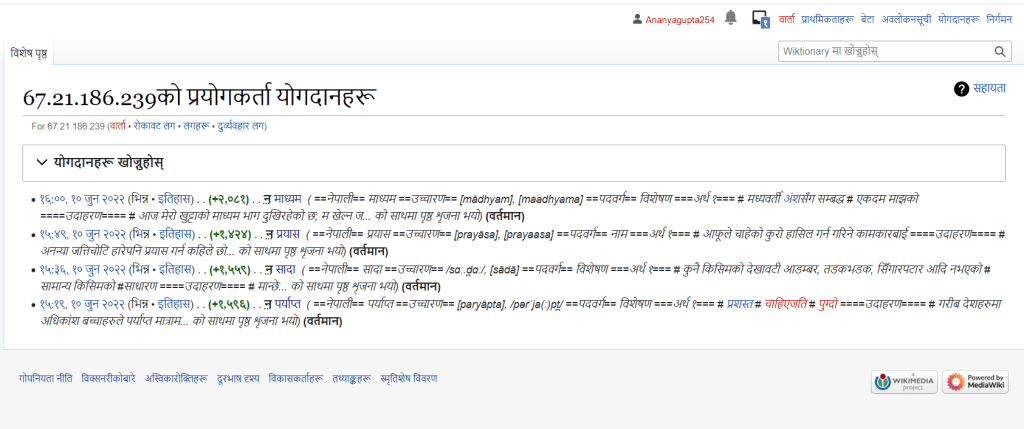
Today, I added all four words to the Nepali Wiktionary successfully and made modifications in the template as needed for proper formatting. I made changes to the template on the website as well. Later, I added the template of word entry both in English and Nepali to the GitHub , “dict-ne” created by David. Additionally, I added two words to the GitHub as examples of word entries in the designed template. The entries to the Wiktionary are in the following fig.:

I am very happy and satisfied to finally be able to add words to the Wiktionary in a proper format like word entries in other languages. Now, I am ready to recruit other people who may be interested in our project and share the template and examples with them.

Week 4 Day 3 & 4: Examples of Word Entry Development & Cyber Defense Onboarding Training Completion

After finalizing the word entry template, I started to work on putting the unlisted word into the template and filled the content with the aim to provide examples to other helpers. Altogether, I put four words into the finalized template as examples. I also revised word entry contents and I used the link: https://en.wiktionary.org/wiki/Wiktionary:Entry_layout to get familiar with the Wiktionary entry layout and followed the following layout to put them in the correct format:

  • word phonetics are written inside [ ]
  • Definition of words are written with “#” in the beginning
  • Examples of words are written with “#:” in the beginning
  • Synonyms and Derived terms are written with {{ }} in the link format so that if the words are not listed then, other people can click on it and figure it out easily and will be able to add words if interested.
  • The reference section is also written in “”word link”, author, title, place of publication, publisher, and year of publication” format.

Using the above-mentioned layout (rules), I added examples of word entries which are as follows:

==नेपाली==
पर्याप्त

===उच्चारण===
[paryāpta], /pəɾˈja(ː)pt̪/

===पदवर्ग===
विशेषण

====अर्थ १====
#प्रशस्त #चाहिएजति #पुग्दो

====उदाहरण==== 
#:१. गरीब देशहरुमा अधिकांश बच्चाहरुले पर्याप्त मात्रामा पोषित खाना खान पाउदैनन।
#:२. एउटा मान्छेलाई दिनको ५-६ लिटर पानी खानु पर्याप्त हुन्छ।

====अर्थ २====
#पाइएको #प्राप्त

====उदाहरण==== 
#:१. रामले छोरा पर्याप्तगर्नकालागि हवन गराएका थिए। 
#:२. 

====अर्थ ३====
#समर्थ

====उदाहरण==== 
#:१. मनु पढ्नमा पर्याप्त भएकोलेगर्दा अमेरिकामा पूर्ण छात्रवृतिमा उच्च शिक्षा पढ्न पाई। 
#:२. 

===समानार्थी शब्द=== 
[[काफ़ी]][[लात्तिकुत्ती]] 

===व्युत्पन्न सर्तहरू=== 
[[पर्याप्त मात्रामा]][[पर्यप्ति]][[पर्याप्तता]] 

===अनुवाद=== 
अङ्ग्रेजी: [[enough]][[ample]][[sufficient]][[adequate]][[suffice]]

===उल्लेख===
"Word link" in Nepali Sabdakosh, Nobal Niraula
==नेपाली==
सादा

===उच्चारण===
/sɑː.d̪ɑː/, [sādā]

===पदवर्ग===
विशेषण

====अर्थ १====
#कुनै किसिमको देखावटी आडम्बर, तडकभडक, सिँगारपटार आदि नभएको #सामान्य किसिमको #साधारण

====उदाहरण==== 
#:१. मान्छेले सादा जीवन जिउनुपर्छ तर उच्च विचार राख्नुपर्छ।  
#:२. 

====अर्थ २====
#रङ्गहीन #बुट्टा आदि नभएको

====उदाहरण==== 
#:१. रमा सादा लुगा लगाउन मन पराउछिन्। 
#:२. 

====अर्थ ३====
#छलकपट नभएको #मनमा एक थोक मुखले अर्को थोक गर्न नजान्ने 

====उदाहरण==== 
#:१. खेमराजलाई गाउकै सबैभन्दा सादा (सोझो) मान्छे भनेर चिन्छन्। 
#:२. मयुरी एकदमै सादा स्वभावकी छिन्। 

===समानार्थी शब्द=== 
[[सरल]][[सोझो]][[साधारण]][[सामान्य]]

===व्युत्पन्न सर्तहरू=== 
[[सादापन]][[सादगी]]

===अनुवाद=== 
अङ्ग्रेजी: [[simple]][[plain]][[innocent]][[sober]]

===उल्लेख===
"Word link" in Nepali Sabdakosh, Nobal Niraula 
==नेपाली==
प्रयास

===उच्चारण===
[prayāsa], [prayaasa]

===पदवर्ग===
नाम 

====अर्थ १====
#आफूले चाहेको कुरो हासिल गर्न गरिने कामकारबाई


====उदाहरण==== 
#:१. अनन्या जत्तिचोटि हारेपनि प्रयास गर्न कहिले छोडिनन्। 
#:२. 

====अर्थ २====
#परिश्रम #आयास

====उदाहरण==== 
#:१. प्रयासको फल जहिले मिठो हुन्छ। 
#:२. प्रयास कहिलै बेकार जादैन; कि त जित्छ कि त केहि सिक्छ। 

====अर्थ ३====
#उद्योग #उन्नति

====उदाहरण==== 
#:१.  मनिषले सधै प्रयासको मार्गमा लम्कनुपर्छ। 
#:२. 

===समानार्थी शब्द=== 
[[कोशिश]] [[जमर्को]] [[प्रयत्न]]

===व्युत्पन्न सर्तहरू=== 
[[प्रयासरत]][[प्रयासहीन]][[प्रयासी]][[प्रयासशील]][[प्रयससाध्य]]

===अनुवाद=== 
अङ्ग्रेजी: [[try]][[attempt]][[strive]][[progress]][[endeavor]]

===उल्लेख===
"Word link" in Nepali Sabdakosh, Nobal Niraula
==नेपाली==
माध्यम

===उच्चारण===
[mādhyam], [maadhyama]

===पदवर्ग===
विशेषण 

====अर्थ १====
#मध्यवर्ती अंशसँग सम्बद्ध #एकदम माझको

====उदाहरण==== 
#:१. आज मेरो खुट्टाको माध्यम भाग दुखिरहेको छ; म खेल्न जान सक्दिन होला। 
#:२. मीरालाई टाउको को मध्यम भागमा चोट लागेर सुन्नेको छ। 

====अर्थ २====
#कुनै काम सिद्ध गर्ने साधन वा उपाय #नै काम सम्पन्न गर्ने साधन वा व्यक्ति

====उदाहरण==== 
#:१. मंजुले आफ्नो कामको प्रचारप्रसारगर्नलाई फचेबूक तथा समाचारपत्रजस्ता माध्यम प्रयोग गरिरहेकी छे। 
#:२. नेताहरुले झुठो आस्वाशन दिएर गरिब तथा सोझो जनताहरुको माध्यमबाट धेरै मत ल्याउन सफल हुन्छन, तर पछि उन्का मागहरु कहिलै पुरा गर्दैनन्। 

===समानार्थी शब्द=== 
[[केन्द्रीय]][[बिच्चको]][[तरिका]][[मध्य]]

===व्युत्पन्न सर्तहरू=== 
[[माध्यमिक]][[माध्य]][[माध्याह्निक]][[माध्यमिक शिक्षा]][[माध्यमिक विद्यालय]]

===अनुवाद=== 
अङ्ग्रेजी: [[medium]][[media]][[means]][[middle]][[channel]][[channels]][[central]][[middling]]

===उल्लेख===
"Word link" in Nepali Sabdakosh, Nobal Niraula

Cyber Defense Onboarding Curriculum_Day 15_2022:

Today, I completed the training assigned to me by the Cyber Defense Awareness Team. Upon completion, I learned about four different cyber security teams such as Information Security teams, Awareness team, etc. along with their purposes and responsibilities. Now, I know that if my data or physical devices are lost then, who I should contact. Also, I learned how to keep my data secure. Some of the examples are:

  • Logging into VPN instead of public WiFi,
  • Never plug in only the data cable in public places or in someone else’s house but always carry and use a power socket which prevents the possibility of data sharing and breaching.
  • Always erase private code or passwords from the whiteboards after each meeting
  • Always sit in facing wall when using electronic devices such as laptop or mobile phones while sitting in the cafe or public places to prevent shoulder surfing threats.
  • Always double check children’s electronics to confirm they are only watching or viewing eligible contents
  • Save all password in one place and create a passphrase to access them and remember that in memory.
  • There are two types of data: restricted and confidential along with some examples that fall under each group.

Week 3 Day 5: Recruitment Preparation for Side Project “Nepali NLP Initiative”

Social Media Forum

Along with the website, I have also created a Facebook Discussion Forum called “Nepali NLP Forum” using which I am inviting people in my friend list and others who would be interested to involve in our project and will most probably contribute to making the initiative successful. I have linked the following forum on our website as well:

https://www.facebook.com/groups/446813650585729

Press Release for Recruitment

I am currently working on writing a press release that will be shared on the Facebook forum and with personal contacts through email. Using this official press release, I will recruit participants who would be interested to contribute amplifying the Nepali Wiktionary and putting words in a more organized format. You can view the Press release at https://nepalinlp.org/nepali-nlp-initiative/?preview_id=415&preview_nonce=fbfb1ab3c1&preview=true&_thumbnail_id=421

Week 4 Day 1: Word Entry Template Development Initiation

Today, I started working on writing the format of word entry in Wiktionary. First, I did research to understand and get familiar with the format words are added in Wiktionary and online dictionaries along with the contents. When I compared word entry in Nepali Wiktionary vs. Wiktionary in other languages such as English, Hindi, etc. I came to know that currently, the words that are listed in Nepali Wiktionary do not give complete information about the very word. For example, phonetics or pronunciation, all parts of speech along with various meanings if applicable, synonyms, translation in English and other languages, etc. are either missing for most words or are not added in a proper format. In my opinion, if all the Nepali words would be added in a standard and proper format, it can be a great foundational resource for people who would be interested to work in NLP in Nepali in areas such as sentiment analysis in the Nepali language, creating Nepali dictionary, Word Sense Disambiguity (WSD), etc. Therefore, after doing research and looking at templates on other dictionaries and Wiktionary of other languages I came up with the following template that can be used to insert words to the Nepali Wiktionary:

  1. Word | Phonetics/Pronunciation
  2. Parts of Speech: meaning 1
    • Examples of use in sentences
  3. Parts of Speech: meaning 2..
    • Examples of use in sentences
  4. Synonyms
    • synonym1 , synonym 2, …
  5. Translation
    • English

Wikitext format in Nepali:

  1. == शब्द == [word]
    • === उच्चारण === [pronunciation]
    • === पद वर्ग १ === [नाम/ सर्वनाम/ क्रिया / …] [part of speech 1]
      • ==== अर्थ १ ==== [meaning 1]
      • ==== उदाहरण ==== [example]
        • १. उदाहरण
        • २. उदाहरण
      • ==== अर्थ २ ==== [meaning 2]
      • ==== उदाहरण ==== [example]
        • १. उदाहरण
        • २. उदाहरण
      • ==== अर्थ ३ ==== [meaning 3]
      • ==== उदाहरण ==== [example]
        • १. उदाहरण
        • २. उदाहरण
    • === पद वर्ग २ === [नाम/ सर्वनाम/ क्रिया / …] [part of speech 2]
      • ==== अर्थ १ ==== [meaning 1]
      • ==== उदाहरण ==== [example]
        • १. उदाहरण
        • २. उदाहरण
      • ==== अर्थ २ ==== [meaning 2]
      • ==== उदाहरण ==== [example]
        • १. उदाहरण
        • २. उदाहरण
      • ==== अर्थ ३ ==== [meanning 3]
      • ==== उदाहरण === [example]
        • १. उदाहरण
        • २. उदाहरण
    • === समानार्थी शब्द === [synonyms]
    • === अनुवाद === [translation]
      • अङ्ग्रेजी: [English]

Wikitext format in English:

  1. == Word ==
    • === Pronunciation ===
    • === part of speech 1 === [Noun/Pronoun/Verb/Adjective…]
      • ==== Meaning 1 ====
      • ==== Example ====
        • Example 1
        • Example 2
      • ==== Meaning 2 ====
      • ==== Example ====
        • Example 1
        • Example 2
      • ==== Meaning 3 ====
      • ==== Example ====
        • Example 1
        • Example 2
    • === Part of speech 2 === [Noun/Verb/Adverb/Adjective…]
      • ==== Meaning 1 ====
      • ==== Example ====
        • Example 1
        • Example 2
      • ==== Meaning 2 ====
      • ==== Example ====
        • Example 1
        • Example 2
      • ==== Meaning 3 ====
      • ==== Example ===
        • Example 1
        • Example 2
    • === Synonyms ===
    • === Translation ===
      • English

Week 4 Day 2: Word Entry Wikitext Template Development Cntd..

Today, I continued working on writing and revising the format of word entry in Wiktionary in the wikitext format both in Nepali and English. The following is the revised version of the wikitext format in Nepali. In revision, I added derived terms and a reference section.

Wikitext format in Nepali:

==नेपाली== 
===उच्चारण=== 
===पद वर्ग १=== 
====अर्थ १==== 
====उदाहरण==== 
#:१. उदाहरण
#:२. उदाहरण
====अर्थ २====
====उदाहरण==== 
#:१. उदाहरण
#:२. उदाहरण
====अर्थ ३==== 
====उदाहरण==== 
#:१. उदाहरण
#:२. उदाहरण
===पद वर्ग २=== 
====अर्थ १==== 
====उदाहरण==== 
#:१. उदाहरण
#:२. उदाहरण
====अर्थ २==== 
====उदाहरण==== 
#:१. उदाहरण
#:२. उदाहरण
====अर्थ ३==== 
====उदाहरण=== 
#:१. उदाहरण
#:२. उदाहरण
===समानार्थी शब्द=== 
===व्युत्पन्न सर्तहरू=== 
===अनुवाद=== 
अङ्ग्रेजी:   
===उल्लेख===      

Wikitext format in English:

Based on the advice of my mentor, David, I also decided to add wikitext format in the English version for broader outreach which is as follows:

=Nepali== 
===Pronunciation=== 
===part of speech 1=== 
====Meaning 1==== 
====Example==== 
#:Example 1
#:Example 2
====Meaning 2==== 
====Example==== 
#:Example 1
#:Example 2
====Meaning 3==== 
====Example==== 
#:Example 1
#:Example 2
===Part of speech 2===  
====Meaning 1==== 
====Example==== 
#:Example 1
#:Example 2
====Meaning 2==== 
====Example==== 
#:Example 1
#:Example 2
====Meaning 3==== 
====Example=== 
#:Example 1
#:Example 2
===Synonyms=== 
===Derived terms=== 
===Translation=== 
English

Week 3 Day 2: Cyber Defense Onboarding Curriculum_Day 15_2022 Training Initiation

I started another training assigned by the Cyber Defense Awareness Team. This training is titled as “CDA-RSG Cyber Defense Onboarding Curriculum_Day 15_2022” and it is due on June 14th, 2022.

I have initiated this training and I have completed up to episode 3. While taking this training, I learned how can our data be stolen for example, through shoulder surfing, logging in to public WiFi, etc. Also, I learned to always lock the computer and electronic devices after use or if left unattended. We should always save passwords in the form of passphrases because it is hard to guess or hack.

Week 3 Day 3 & 4 : Side Project Initiation and Development

Side Project Initiation

Motivation, Planning, and Goals:

Nepali Wiktionary is currently unorganized and small. It would be very time-consuming and ineffective to work alone on this project. Therefore, I started a side project for which I have registered a domain name called nepalinlp.org and it is hosted on the server of my mentor, David De Hilster. With this side project, my goal is to recruit enthusiastic CS, NLP, and linguists in the Nepali language and develop a more organized and structured Wiktionary. I did background research and came up with a word entry template to add unlisted words to Nepali Wiktionary that will give complete information about the very word to the audience which is as follows:

Word | Phonetics/Pronunciation

  1. Parts of Speech: meaning 1
    • Examples of use in sentences
  2. Parts of Speech: meaning 2..
    • Examples of use in sentences
  3. Synonyms
    • synonym 1 , synonym 2, …
  4. Translation
    • English

Using the above format, I will add 20-30 unlisted Nepali words to Wiktionary using NLP++ and HPCC Systems which will act as a template for other enthusiastic people who would be ready to volunteer in this initiative with me. The words will be parsed using NLP++ and will run those analyzers on HPCC Systems. The HPCC Systems and NLP++ & VisualText webpages are linked under “Technology” in the website as well. In this way, I will be able to bring the attention of more people to HPCC Systems and their uses. Simultaneously, I will be able to achieve the project goal by making Nepali Wiktionary ample and in a more structured and useful format.

Words to Add in Wiktionary

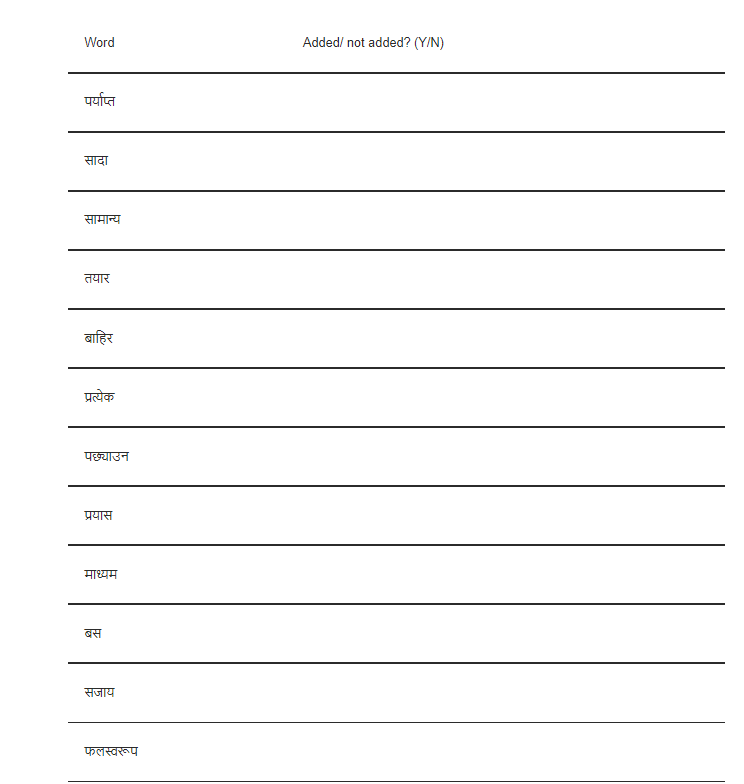
I also started to create a dataset where I am adding all the Nepali words that are currently unlisted in the Wiktionary. Some of the words are as follows:

Week 2 Day 5: Planning for Next Week

Today, I and my mentor discussed possible ways we can proceed with this project. Since I started with small data and parsed the “1000 most common Nepali words” dataset. Now, my goal is to do background research on Wiktionary, get familiar with the format words are added to Wiktionary, lookup common Nepali words whether the very words exist in Wiktionary. If not, my goal will be to go through history and recent changes that people have made to Nepali Wiktionary. Then, I will work on deciding which format and what content I would like to add to the Nepali Wiktionary. The content may be words, its categorization for parts of speech along with different meaning(s) of that particular word both in Nepali and English, phonetic, example sentences having those words used, etc. Once the content will be decided I will create a template and add that in my personal website.

After that, my task will be to write a press release to request all Computer Science(CS), NLP in Nepali, and linguistics enthusiasts to come together and work following the template and add unlisted Nepali words to Wiktionary.

Week 2 Day 4: Running NLP++ Analyzers on Actual Nepali Data

I continued parsing text extracted from “1000 most common Nepali words” webpage. With the guidance of my mentor, I created more NLP++ pass having rules to parse rows and columns and remove whitespaces, used built-in library such as KBFuncs, created other NLP++ passes such as KbInit, KbBuild and KbDisplay to parse and display the output in a specific format.

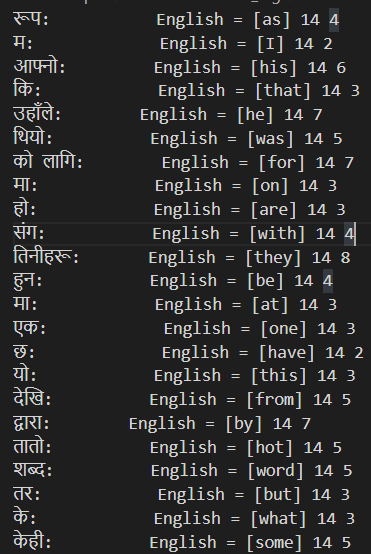
Fig.1: Output obtained by using KBFuncs after parsing

My goal was to display the Nepali words and English translation of those words next to each other in the same line with a colon in between and space equals to maximum number of bytes of longest word or phrase to put in the format as similar to columns in table. In this way, all the translated English word align next to Nepali words at the same place for better look and quick search. We could able to accomplish to put words with better alignment approximate to table format by adding colon just after each Nepali word and put English translation of those words in “English = [English word]” format as shown above in fig.1. However, we still couldn’t put it exactly like in a column aligned in the table. This is because the space taken by each character in English and Nepali is different. We found that a Nepali word having exactly an equal number of characters takes less space than an English word. Not only that, even Nepali words having equal number of character may also take different number of space/byte as shown in row 5 and 7, row 8 and 9. Though these Nepali words are of equal number of bytes, but one takes less space than others. To resolve this issue, we should convert all unicode to fixed width. Right now, NLP++ doesn’t support non-proportional font. Therefore, I could not put parsed words aligned all words in each rows to one place as in columns of the table.

In conclusion, today, I learned to use built-in library functions and create passes by calling functions to parse words in the desired format and display the final output either in .txt or .kbb file.